
Colorado VOAD Subcommittees
COVOAD Subcommittees are not tied to a particular disaster, and instead activate to coordinate and align efforts across members, partners, and with support and guidance from government counterparts/liaisons during a Colorado VOAD disaster specific activation. Subcommittee leads will support service requests, help to identify and share unmet needs, and report out updates during Colorado VOAD coordination calls. During blue sky times focus on their subject matter expertise throughout the year to create guidance documents, best practices, and other resources for the VOAD membership and the general public will be vital. You can find some of those resources here.
Goal & Strategic Objective
- Internal member information sharing, external PR, and emergency alert coordination
- Vetted resource updates and sharing across membership
- Social media updates
- Website updates
- will create a disaster specific resource page with up to date information, resources, and active VOAD members under the the Disaster Events menu on covoad.org
- Captures photos of COVOAD members and partners at events, during response efforts, in action throughout the year!
- Manages all social media accounts and updates (Twitter, LinkedIn, Facebook, etc.)
- Assists with COVOAD monthly newsletter when able.
Leadership
-
Subcommittee Lead(s): Nathan Fair, The Salvation Army, Nathan.Fair@usw.salvationarmy.org
Current Subcommittee Members
-
Kim Christensen, Mile High United Way, 211 Colorado, Kim.Christensen@unitedwaydenver.org
Operational Process & Reporting
-
Blue Sky (Preparedness): This group meets monthly/quarterly to align resources, conduct training, and map statewide assets.
-
During Activation (Response): Members transition to active coordination calls. The Lead provides regular status reports to the greater COVOAD leadership to identify resource gaps and streamline member offerings.
How to Join We welcome all COVOAD members with relevant expertise or a desire to support this specific functional area. To join the mailing list or participate in the next kickoff meeting, please reach out to the subcommittee lead: Nathan Fair, The Salvation Army, Nathan.Fair@usw.salvationarmy.org
Strategic Objectives:
- Encourage unified Colorado VOAD use of the online Situational Reporting Form (SitRep) for impact tracking
- Example: Tracking overnight stays at sheltering, households served, # of meals served, snacks served, pallets of water or donations, etc.
- Guide and share impact tracking best practices
- Review and update the online SitRep Form annually
- Annual Impact Reporting and Sharing
- Information sharing assisting response efforts from local, state, and federal levels?
Committee Chair: Mike Acres, American Red Cross, mike.acres3@redcross.org
Committee Members: TBD
How to Join We welcome all COVOAD members with relevant expertise or a desire to support this specific functional area. To join the mailing list or participate in the next meeting, please reach out to the subcommittee lead: Mike Acres, American Red Cross, mike.acres3@redcross.org
Goal & Strategic Objective: Coordinate the delivery of life-sustaining services including feeding, sheltering, and bulk distribution for both humans and animals during disaster activations. By leveraging the “4 Cs” (Collaboration, Coordination, Cooperation, and Communication), this group ensures that vulnerable populations and their livestock or pets receive the integrated resources they need to transition from crisis to recovery. During “Blue Sky” periods, members meet periodically to map statewide assets and conduct preparedness training, while disaster activations shift the focus to real-time resource deployment and statewide status reporting.
Leadership
-
Subcommittee Lead(s):
-
Jaclyn Kurle, Mass Care Emergency Manager, ESF6, Colorado Department of Human Services
-
Current Subcommittee Members:
- American Red Cross
- Dennis Belz, Colorado Southern Baptist Disaster Response
- Ian Anderson, The Salvation Army
- Curtis Garrett, Atlantis Community, Curtis@atlantiscommunity.org
Goal & Strategic Objective
- Donations Management: Managing unsolicited goods, “Gifts-in-Kind,” and warehouse logistics.
- Establishing a coordinated and aligned collective approach to in-kind and monetary donations as well as volunteer management plans across members and partners before the disaster occurs
- In partnership & guided by the Division of Homeland Security and Emergency Management (DHSEM) Plans, MOU’s, and direction
- Leads regular meetings to ensure alignment across membership and response efforts in coordination with government entities during the disaster
- Creates, maintains, or shares best practices, SOP’s, MOU’s, trainings and more to set the standard for donation management
Leadership
-
Subcommittee Lead(s): Cathy Kissner, Adventist Community Services, cathyk@rmcsda.org
Current Subcommittee Members
-
Kaila Green, Food Bank of the Rockies, Direct Services Supervisor, kagreen@foodbankrockies.org
Operational Process & Reporting
- Blue Sky (Preparedness): This group meets [Quarterly/Monthly] to align resources, conduct training, and map statewide assets.
- During Activation (Response): Members transition to active coordination calls. The Lead provides regular status reports to the greater COVOAD leadership to identify resource gaps and streamline member offerings.
How to Join We welcome all COVOAD members with relevant expertise or a desire to support this specific functional area. To join the mailing list or participate in the next kickoff meeting, please reach out to the leads:
-
Point of Contact: Cathy Kissner, Adventist Community Services, cathyk@rmcsda.org
Goal & Strategic Objective: Volunteer Management
Best practices for spontaneous volunteer management and VRC (Volunteer Reception Center) operations.
Leadership
-
Subcommittee Lead(s): Jaime Valle, ToolBank Disaster Services, Territory Manager, jaime.valle@toolbank.org
Current Subcommittee Members
-
TBD
Operational Process & Reporting
- Blue Sky (Preparedness): This group meets [Quarterly/Monthly] to align resources, conduct training, and map statewide assets.
- During Activation (Response): Members transition to active coordination calls. The Lead provides regular status reports to the greater COVOAD leadership to identify resource gaps and streamline member offerings.
How to Join We welcome all COVOAD members with relevant expertise or a desire to support this specific functional area. To join the mailing list or participate in the next kickoff meeting, please reach out to the leads:
-
Point of Contact: ColoradoVOAD@gmail.com
Goal & Strategic Objective
Aligned and coordinated efforts to ensure all debris removal & cleanup needs are met including muck-out, chainsaw crews, hazard mitigation, and more.
Leadership
-
Subcommittee Lead(s): Dennis Belz, Colorado Baptist Disaster Response (CBDR), dbelz@coloradobaptists.org
Current Subcommittee Members:
- Jaime Valle, ToolBank Disaster Services, Territory Manager, jaime.valle@toolbank.org
- Eric Larson, Team Rubicon, eric.larson2@teamrubiconusa.org
- Aaron Titus, Crisis Cleanup, aaron@crisiscleanup.org
Operational Process & Reporting
- Blue Sky (Preparedness): This group meets [Quarterly/Monthly] to align resources, conduct training, and map statewide assets.
- During Activation (Response): Members transition to active coordination calls. The Lead provides regular status reports to the greater COVOAD leadership to identify resource gaps and streamline member offerings.
How to Join We welcome all COVOAD members with relevant expertise or a desire to support this specific functional area. To join the mailing list or participate in the next kickoff meeting, please reach out to the leads:
-
Point of Contact: Dennis Belz, dbelz@coloradobaptists.org
Mission & Strategic Objective: The Health & Wellness Subcommittee serves as the central hub for integrating emotional, spiritual, and psychological well-being into Colorado’s disaster response and recovery framework. Our mission is to move beyond traditional crisis intervention by fostering a community-wide culture of care. We coordinate a multi-disciplinary approach to wellness, ensuring that every survivor and responder has access to dignified and culturally sensitive support.
Key Pillars of Support
- Psychological First Aid (PFA): We standardize the delivery of PFA to provide immediate, non-intrusive behavioral health support, helping to stabilize individuals and reduce initial post-disaster distress.
- Chaplaincy & Spiritual Care: Recognizing that disaster recovery is often a spiritual journey, we coordinate with multi-faith chaplaincy services to provide comfort, ritual, and presence for those of all faith backgrounds or no faith background.
- Public Health Coordination: We work in lockstep with Public Health teams to align mental health resources with physical health initiatives, ensuring a seamless whole-person approach to community wellness.
Leadership
-
Subcommittee Lead(s):
- Phyllis Kane, Program Director Disaster Relief, Lutheran Family Services Rocky Mountains, phyllis.kane@lfsrm.org
- Paul Johnson, Mennonite Disaster Services, doctorpj52@gmail.com
- Brenda Fox, Mennonite Disaster Services, prayerstream@mountainstatesmc.org
Committee Members:
- Maggie Babyak, Our Front Porch, maggie@ourfrontporchco.org
Meeting & Reporting Process
- Blue Sky Periods (Preparedness): The subcommittee meets quarterly to map statewide wellness assets, conduct PFA training, and build relationships between faith-based organizations and health departments.
- During Activation (Response): We transition to active coordination, managing the deployment of trauma-informed resources and spiritual care teams. Leadership provides essential report-outs during statewide COVOAD coordination calls to identify gaps in emotional and spiritual care across the affected area.
How to Join
We are looking for inclusive voices from across the spectrum of care—including licensed clinicians, spiritual leaders, public health advocates, and community organizers. To join our subcommittee or to register your organization’s trauma-informed resources for future activations, please contact Brenda Fox and Phyllis Kane via the email’s listed above.
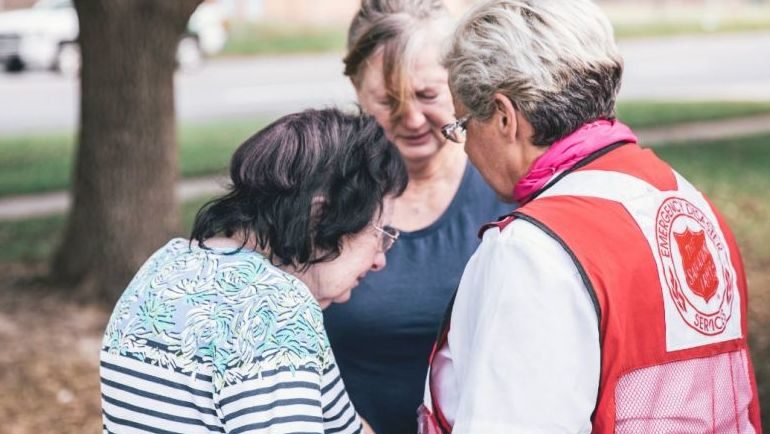
Historical Context: The Disaster Spiritual Care Committee’s mission is to foster emotional and spiritual care to people affected by disaster in cooperation with state and local response organizations and VOAD organizations. The idea for a ‘COVOAD Emotional & Spiritual Care (ESC) Committee’ was conceived in the summer of 2013 after disaster responses highlighted the need and desire for disaster spiritual care providers (2012 fires, 2013 fires & 2013 flood). At the same time, the statewide disaster behavioral health response network, the Colorado Crisis Education & Response Network (CoCERN) expressed a desire to complement behavioral health response with a spiritual care response cadre to address often unmet spiritual care needs. The COVOAD DSC accomplishes its mission in several ways:
Embracing the unique contribution of various mental health disciplines and faith-based groups.
Identify specific issues of emotional and spiritual needs as a significant component of disaster response.
Educate state and local VOADs and non-affiliated partners about emotional and spiritual needs in disasters.
Promote best practices, standards, and models to provide effective emotional and spiritual care.
All COVOAD faith-based member organizations adhere to National VOAD’s Disaster Spiritual Care Guidelines.
Goal & Strategic Objective
Standup and support Disaster Case management & Legal Services efforts for impacted survivors: Guidance on insurance, legal aid for survivors, ensuring equitable access to services for underserved populations.
Leadership
-
Subcommittee Lead: Phyllis Kane, Lutheran Family Services, Phyllis.Kane@lfsrm.org
Current Subcommittee Members
- Heather Korth, Our Front Porch, COO, heather@ourfrontporchco.org
Operational Process & Reporting
- Blue Sky (Preparedness): This group meets [Quarterly/Monthly] to align resources, conduct training, and map statewide assets.
- During Activation (Response): Members transition to active coordination calls. The Lead provides regular status reports to the greater COVOAD leadership to identify resource gaps and streamline member offerings.
How to Join We welcome all COVOAD members with relevant expertise or a desire to support this specific functional area. To join the mailing list or participate in the next kickoff meeting, please reach out to the lead:
- Point of Contact: Phyllis Kane, Lutheran Family Services, Phyllis.Kane@lfsrm.org
Goal & Strategic Objective Long-Term Recovery Groups (LTRG): Spearheading the guidance and stand-up/formation and health of local LTRGs across Colorado after a disaster. Majority of active subcommittee work will transition into roles and supports within the LTRG, as response transitions into recovery. This subcommittee would take lead in supporting and guiding the transition.
Leadership
-
Subcommittee Lead(s): Ian Anderson, The Salvation Army, Ian.Anderson@usw.salvationarmy.org
Current Subcommittee Members
- Aaron Titus, Crisis Cleanup, aaron@crisiscleanup.org
- Jaime Valle, ToolBank Disaster Services, Territory Manager, jaime.valle@toolbank.org
- Curtis Garrett, Atlantis Community, Curtis@atlantiscommunity.org
- Heather Korth, Our Front Porch, COO, heather@ourfrontporchco.org
Operational Process & Reporting
- Blue Sky (Preparedness): This group meets [Quarterly/Monthly] to align resources, conduct training, and map statewide assets.
- During Activation (Response): Members transition to active coordination calls. The Lead provides regular status reports to the greater COVOAD leadership to identify resource gaps and streamline member offerings.
How to Join We welcome all COVOAD members with relevant expertise or a desire to support this specific functional area. To join the mailing list or participate in the next kickoff meeting, please reach out to the lead:
-
Point of Contact: Ian Anderson, The Salvation Army, Ian.Anderson@usw.salvationarmy.org