
Evacuees and Survivors
Quick Guidance
The Aspen Acres Fire is still active, and response efforts are ongoing in Custer and Pueblo Counties. Emergency crews, local agencies, and disaster relief organizations are working together to support people affected by the fire.
Recovery from a wildfire takes time and usually happens in stages. Here is the order most survivors will move through:
- Contact your insurance company first. If you have homeowner’s, renter’s, or auto insurance, start your claim as soon as you can. This is usually the fastest source of help for repairing or replacing what you lost.
- Reach out to relief organizations for immediate needs. Groups like the American Red Cross, The Salvation Army, and local nonprofits can help with food, water, shelter, and other urgent needs right now, regardless of insurance or government status.
- Government assistance, if available. No federal disaster declaration has been made for this fire at this time, and one may not be issued for individual assistance. If a declaration is made, FEMA and state programs may offer additional support. We will update this page if that changes.
- Long-term recovery support. As the immediate response winds down, a Long-Term Recovery Group made up of local nonprofits, faith-based organizations, and community partners will form to help with needs that remain after insurance and other aid — things like rebuilding, case management, and connecting survivors to remaining resources.
For information on the fire itself, evacuation status, and a fuller list of available services, please visit:
- 211 Colorado Wildfire Resources: www.211colorado.org/wildfire-resources
- Custer County: https://custercounty-co.gov/
- Pueblo County: https://www.puebloemergency.info/
- Colorado Disaster Recovery Navigation Tool: DisasterRecovery.Colorado.gov
This page will be updated as the response continues and recovery resources develop.
VOAD Members and Community Organizations
How to Get Involved in Recovery
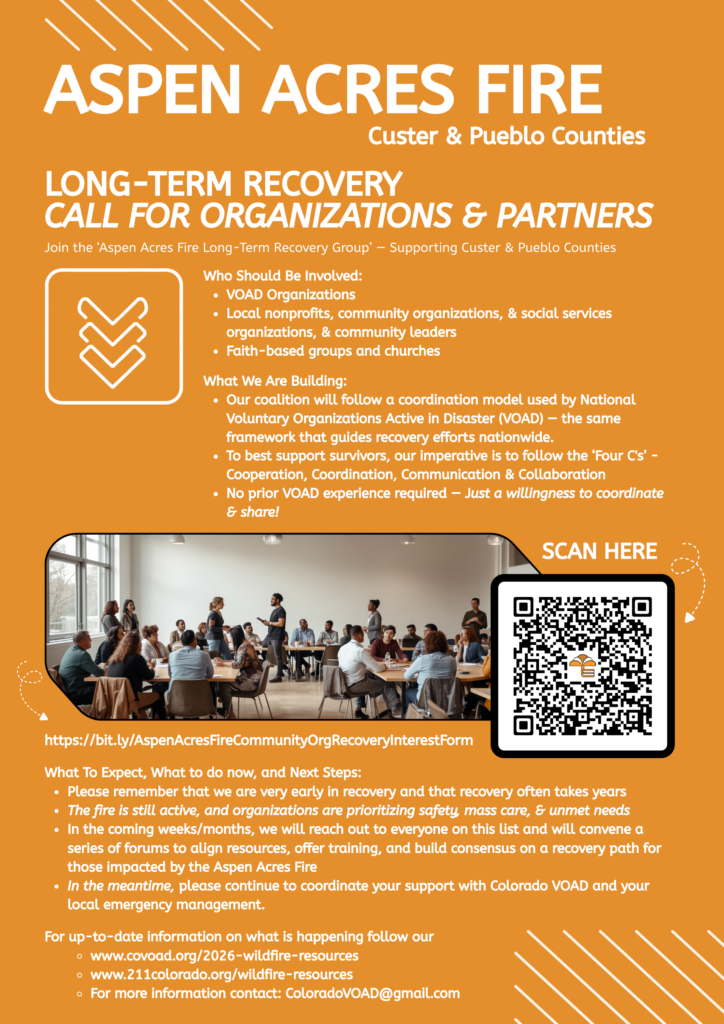
Aspects of community recovery coordinated by VOAD, local nonprofit organizations, social services organizations, and faith-based groups come together as a collective, forming the Long Term Recovery Group follow a coordination model used by National Voluntary Organizations Active in Disaster (VOAD) — the same framework that guides recovery efforts nationwide. If you’re new to this model, here’s what it means for you.
VOAD coordination rests on four principles, often called the Four C’s:
Cooperation — working alongside other organizations rather than in isolation
Coordination — aligning efforts so survivors aren’t sent in circles or served twice while others go without
Communication — sharing information openly so the whole recovery effort has an accurate picture of what’s been done and what’s still needed
Collaboration — pooling resources and expertise so no single organization has to carry the full weight of recovery alone
Member organizations also agree to a set of Points of Consensus — shared standards covering things like case management, spiritual and emotional care, and donations management. These aren’t bureaucratic hurdles. They exist so that a survivor working with any organization at this table gets consistent, respectful, well-coordinated help, and so that assistance dollars go further because they’re not duplicated.
You don’t need prior VOAD experience to join. You need a willingness to coordinate rather than operate independently, and to share information about the assistance you provide so we can track unmet needs accurately across the whole recovery. That’s it. Tell us what you can offer below, and we’ll help you find where it fits.
Our Long Term Recovery Group may end up consisting of several committees, each with a coordinating mission:
- Disaster Case Management Committee
- Donation Management Committee
- Mental Health, Emotional, and Spiritual Care Committee
- Short-Term Housing Committee
- Volunteer Management Committee
- Unmet Needs Committee
Red Cross Disaster Recovery Guide
Learn how the American Red Cross can assist you and your family with lodging, clothing, food, and other emergency disaster-related needs through the Red Cross Disaster Recovery Guide.
Small Business Tool Kit
The Economic Disaster Recovery Project has put together a Guide to Recovery following a disaster for small businesses. This roadmap to recovery covers small business assistance, business retention in a disaster, assessing the economic impact of the disaster, and more.